

In a unanimous 6-0 vote, the Orange County Board of Commissioners passed a one-year pause on large-scale data centers.
The moratorium would apply to large facilities for training artificial intelligence, data processing and cryptocurrency mining. In a news release, county officials said the one-year pause would give their staff time to study the issue, draft language to clearly address data centers, and update its land use policies.
"The Board took this action to ensure we have the time and information needed to thoughtfully evaluate the impacts of large-scale data centers on our community," said Jean Hamilton, chair of the Orange County Board of Commissioners. "This moratorium allows us to protect our natural resources, consider infrastructure demands, and engage residents as we determine the most appropriate path forward for Orange County."
Earlier this year, the town of Apex and Chatham County also passed one-year moratoriums on data centers.
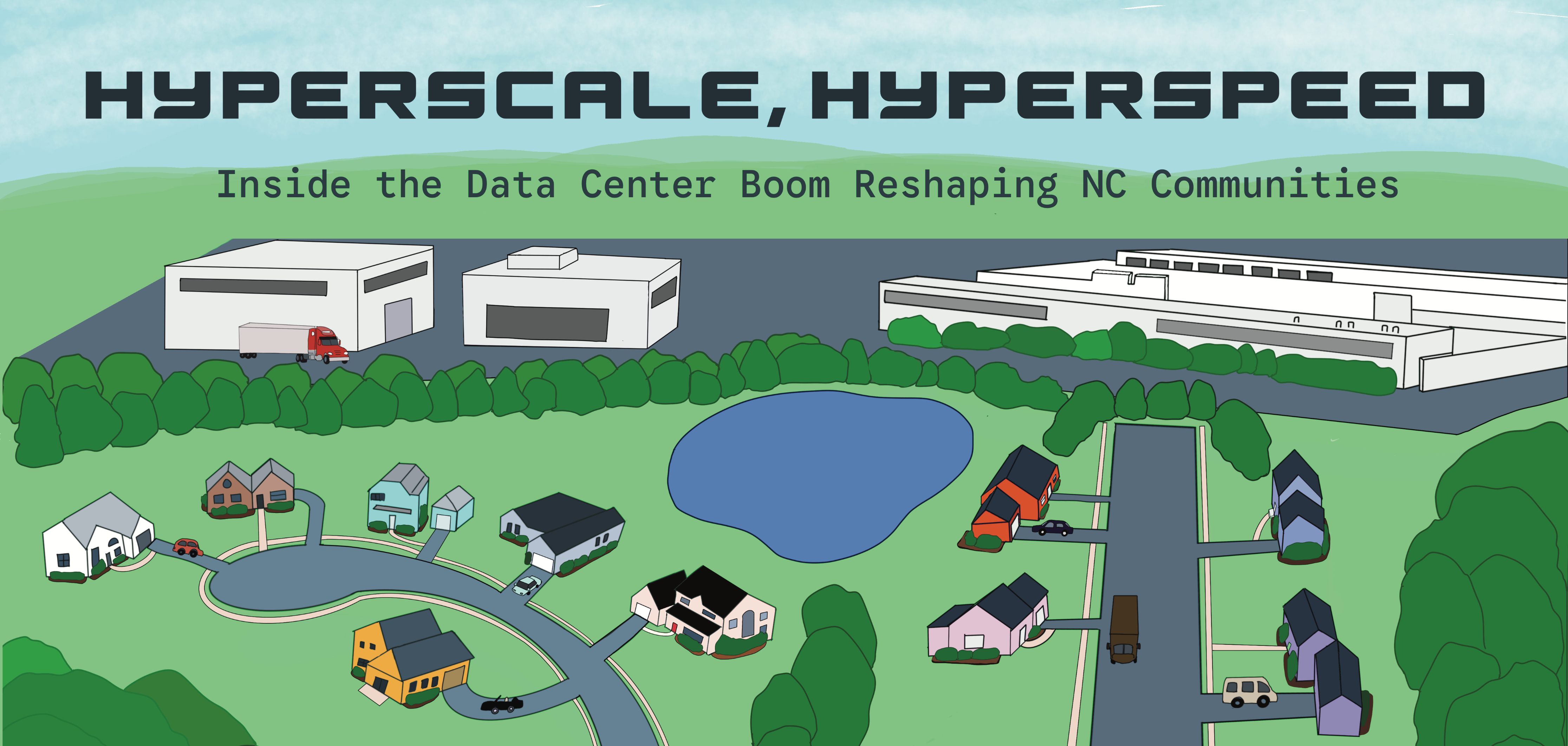
In this 6-part series, BPR, the NC Newsroom, WFAE, and WUNC explore North Carolina's accelerating data-center boom and its real impact on local communities.
Through on-the-ground reporting, document reviews, and conversations with residents, the series examines how Big Tech is reshaping small towns, consuming vast amounts of power, and striking deals that aren't always clear. It explores who benefits, who bears the cost, and why North Carolina has become an appealing target for server farms despite modest public scrutiny. By following the money, the energy demands, and the promises made to communities, the project aims to reveal what's at stake as the cloud moves into the state’s backroads.
There are currently no large-scale data centers in Orange County. As county attorney John Roberts noted at the meeting, there are limited areas where they could be built "because of lack of water." He further noted that there is no mention of data centers in the county's unified development ordinance, so it would be difficult for county staff to know what standards could be applied to these facilities if they were to receive an application for one.
Commissioners also heard testimony from several members of the public at the meeting, all of whom expressed support for the moratorium. They raised concerns about air and noise pollution, and costs of increased water and power consumption. Ashley Parker, who runs a farm north of Hillsborough, noted the current drought conditions in central NC.
"We had the third driest first quarter in North Carolina since 1895. Record low spring rainfall is devastating our crops … this extreme drought should make us all pay attention to how our water is used now," she said. "Orange County has enough needs and wants we don't have resources for. We cannot afford to be the scapegoat for another want that is not compatible with the available resources in our county."
In North Carolina, data center development has accelerated in recent years. There are currently about 100 facilities across the state that account for up to 3% of the state's energy demand, and that is expected to more than double by 2030 with the growing market for artificial intelligence and technologies that require large-scale data centers to operate. A single data center can require as much energy as a power plant generates in a year, according to the Electric Power Research Institute.
For more on this issue, check out our online zine, "Your Community's Guide to Data Centers."
